
24 Sep, 2026


By Sacha Jackman
Your AI-ready intranet starts with the basics. See why AI exposes old intranet problems instead of fixing them.
I’ve spent a lot of time working with organizations to understand why their intranets aren’t working, what employees need from them, and how to make information easier to find, understand and trust.
I am certainly not an AI expert, but the more I learn about AI and its role in the digital workplace, the more I realize that the things that have always made a good intranet good are about to matter even more.
Every week, we hear leaders talking about the potential of AI in the workplace. They want employees to find information faster, reduce repetitive work and make better decisions. AI-powered search, chatbots and digital assistants promise to help do exactly that.
But there’s one question that needs urgent attention first: Is the information powering those tools ready?
The reality is that most organizations aren’t introducing AI into a pristine digital workplace. They’re introducing it into the intranet they already have. And we’ve reviewed enough intranets to know what that can look like. 🫠
Years of accumulated content. Old policies sitting beside new ones. Duplicate pages. Documents with no clear owner. Information buried 10 clicks deep. Navigation based on the organizational structure rather than how employees think about and look for information.
These issues stem from poor governance, planning, and maintenance: A new page gets created because someone can’t find the old one. A document gets uploaded instead of updating the source. A department restructures, but its content stays behind. Someone who owns a page leaves the company, and nobody realizes they were the only person keeping it current. Sound familiar?
Until recently, the biggest consequence was employee frustration.
Where do I find the vacation policy? Is this the latest version? Which of these three pages am I supposed to use?
But the problem is about to get much bigger because AI doesn’t make those problems disappear. In fact, it amplifies them.
There’s a phrase we’ve all heard a million times, but it applies particularly well here: garbage in, garbage out. AI tools rely on the information available to them to provide answers and recommendations.
If your organization’s knowledge is scattered across outdated pages, abandoned documents and competing sources of truth, AI is working from a flawed foundation.
If there are three answers to a question, AI still has three answers to work with. If a policy is outdated, AI doesn’t magically update it. And if important context is buried in a poorly structured document, retrieving that information may not tell the whole story.
The potential consequences go beyond a bad search experience. Incorrect or inconsistent answers can create confusion, reduce employee trust and ultimately make people less likely to use the very AI tools organizations are investing in.
That’s why I think we’re getting ahead of ourselves when we talk about AI as something that will fix the employee experience.
Before asking what AI can do with your intranet, we need to look at what we’re giving it to work with.
One idea that has stuck with me as I’ve been learning more about this space is the shift from responsive design to responsive content (check out this great video to learn more about this)
For years, we’ve thought about whether an intranet works across different devices. Does the page work on desktop? What happens on mobile?
Now, we also need to think about all the different ways the information itself might be used.
An employee might read the full page. They might find one section through search. An AI tool might retrieve part of it to answer a question, summarize it or surface it somewhere completely different from where it was originally published.
That has implications for how we structure and write content.
One concept I’ve found particularly useful from Frank Wolf is durable writing: content that remains clear and meaningful when it is retrieved, summarized or removed from its original context.
For communications professionals, many of the principles are familiar.
Clear headings. Plain language. Useful context. One idea at a time. Meaningful labels. Content that doesn’t require someone to have read the three paragraphs before it to understand what it means.
The technology is new. Good writing isn’t.
The good news is that preparing an intranet for AI doesn’t necessarily mean reinventing everything, it’s about getting the fundamentals right.
When we look at an intranet’s health, four areas stand out as particularly important.
Content is the foundation of any digital workplace. Many intranets are weighed down by outdated information, duplicate content, contradictory guidance, and low-value pages untouched for years.
Employees quickly learn which information they can trust and which they can’t. AI introduces another reason to take that problem seriously.
Organizations need clear, accurate and current sources of truth. That means understanding what content exists, removing what is no longer useful and addressing duplication or conflicting information.
Cleaning up an intranet once isn’t enough. One of the most common issues we see is unclear ownership. And when nobody owns content, nobody is responsible for keeping it current.
Good governance defines who owns what, how often information should be reviewed, what publishing standards to follow, and what happens when content reaches the end of its useful life.
Governance has never been the glamorous part of an intranet project. And for sure AI isn’t going to make it glamorous. But it might finally make the business case for why it matters.
Clear information architecture, intuitive navigation, effective search, consistent labelling and employee-centred journeys have always been important to the intranet experience.
They’re increasingly important in an AI-enabled one.
As Karen Downs writes about information architecture in an AI-driven world, AI-powered search, personalization and chatbots still depend on the structure and quality of the information underneath them.
AI changes the way information is retrieved. It doesn’t eliminate the need to organize that information properly.
This may be the area where communication professionals have the biggest role. Content increasingly needs to work beyond the page it was originally written for.
That means thinking about whether a section can stand on its own. If headings describe what follows. Whether the language is specific rather than ambiguous. If an answer remains accurate when it’s separated from the surrounding content.
In other words, we’re not writing for AI.
We’re writing clearly enough that our content can remain useful wherever and however it’s surfaced.
The challenge for many organizations isn’t recognizing that their intranet needs work. It’s knowing where to start.
Should you clean up the content? Fix navigation? Establish governance? Improve search? Replace the platform? Introduce AI?
Without understanding the current state, it’s difficult to know where your investment will have the greatest impact. That’s why an assessment can be such a valuable starting point.
Look at what’s working. Identify what’s getting in employees’ way. Understand where there are risks. Then create a realistic roadmap rather than trying to fix everything at once.
That might mean starting with some immediate wins: removing outdated content, changing confusing navigation labels or assigning ownership to high-value pages.
Then there are bigger improvements that take more time: restructuring information, introducing stronger governance practices, improving search or rewriting high-priority content.
Finally, there are longer-term technology decisions, including how and where AI should fit into the employee experience.
The goal isn’t a perfect intranet. It’s a trusted one.
Maybe AI finally gives us the business case to clean up years of intranet clutter? I’ll take it.
At Vision2Voice, we’ve spent 26 years helping organizations navigate communications, change and digital workplace transformation. Our Intranet AI Readiness Assessment and Advisory Package takes a critical look at your intranet’s foundation—from content health and information architecture to governance, findability, and writing.
The result isn’t another lengthy report that sits on a shelf. We provide practical recommendations with immediate quick wins, mid-term improvements and longer-term strategic investments so you know where to start and where to go next.
Whether you’re actively exploring AI, considering a new intranet, or simply realizing your current one should work harder for employees, the first step is understanding where you are today.
Before you invest in what AI can do with your intranet, make sure your intranet is giving it something worth working with.
Ready to see where your intranet stands? Book an Intranet AI Readiness Assessment and Advisory Package. Contact Sacha Jackman ([email protected]) to learn more.

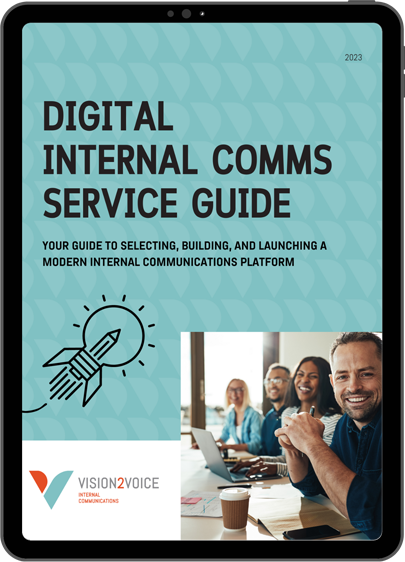
Get your free copy and be the first to hear about other resources, events, and content to help you take your IC game to the next level!
Get your free copy when you subscribe to our newsletter. Be the first to know about new blog posts and get valuable insights and ideas to improve your internal communications and build an awesome employee experience.

Get your free copy when you subscribe to our newsletter. Be the first to know about new blog posts and get valuable insights and ideas to improve your internal communications and build an awesome employee experience.
