
24 Sep, 2026


It’s one of corporate life’s favourite buzzwords, and one of the most common things leaders ask us for. But ask what alignment really looks like, or how to build it, and no one seems to have a clear answer. I do: it’s the right internal communication strategy.
In my experience working with organizations, misalignment isn’t a single problem. It’s a set of challenges that show up as fragmentation, silos, unnecessary friction, and the sense that everyone is rowing in different directions. The bottom line is that they all weaken performance and hold organizations back.
Many people see a lack of alignment as a business problem – and it is. But I see it as a strategic internal communication problem.
Sometimes the best way to spot misalignment is to understand the problems that surface when it’s not there. Here’s how misalignment has shown up in our work:
The research reflects what we’ve seen in our work. A recent Dayforce study found that only 42 percent of frontline workers believe leaders understand the challenges they face. Even more telling, research from Oxford University’s Saïd Business School found that while 91 percent of executives believe strategic alignment is critical to business success, only one in seven strongly agreed their organization is aligned.
Leaders know alignment matters. What many need is a partner who can help them build an internal communications strategy to get there.
Most leaders assume employees understand the organization’s vision and strategy. They share it once or twice a year and consider the job done. We know it isn’t. Some studies suggest as few as 5 percent of employees understand their organization’s strategy. In our internal communication audits, understanding the organization’s direction consistently ranks among the top pieces of information employees want to receive but don’t.
Your internal communication strategy should turn your company’s purpose and strategy into a drumbeat and weave it into every communication. Build it into the editorial calendar, give leaders consistent language, and connect every message, update and change communication. Most of all, it should connect the work your people do every day to where you are going and why.
Shared values are one of the most powerful alignment tools we have. Reinforced consistently, they become a common lens for decision-making and collaboration across teams, functions, and locations.
I still remember my first corporate job, where our CEO opened every town hall by putting our company values up on an overhead projector (anyone remember those?). Leaders consistently tied every decision, initiative, and announcement back to those values, and they became a unifying force. Help your leaders do the same with an internal communication strategy that incorporates values as a key theme.
Stories have been used for thousands of years to help people make sense of the world, understand different perspectives, and learn. Use them to create alignment by helping people understand work beyond their own team and see how it contributes to the organization’s success.
I once worked with an organization where environmental, social and governance (ESG) was widely seen as a barrier to getting work done. By sharing stories that challenged that perception, we changed the conversation. Employees began to see ESG as a contribution to business success, not an obstacle. Use storytelling deliberately to build alignment and make sure it’s highlighted in your internal communication strategy.
George Bernard Shaw famously observed that “the single biggest problem in communication is the illusion that it has taken place.” Too often, organizations assume alignment exists just because they sent a message. But reach isn’t results, and open rates won’t tell you whether people understand the strategy.
Work with your leaders to define what alignment looks like, then build a dashboard to measure and monitor it. Do employees understand the organization’s priorities? Can managers explain the strategy consistently? Are teams making decisions that reflect the vision and values? The answers show where alignment needs attention, and they give communication professionals a stronger voice in strategic conversations.
Building alignment is difficult without trust. And here’s the bad news: trust in organizations is declining at an alarming rate; employees feel mistrusted and are increasingly losing faith in their leaders.
I like to think of trust as the lubricant that makes things go faster—all in the same direction. Studies show that when trust increases, engagement does too, which matters because engagement reflects how an employee views their organization and how much energy and focus they put into their work.
Trust is built through transparency, honesty and consistency between words and actions. At our internal communications agency, we develop strategies for clients that deliberately build trust by helping leaders explain the why behind decisions, be open about what they don’t yet know, and follow through on commitments, because action demonstrates what words alone cannot.
Alignment doesn’t mean everyone agrees on everything. That’s unrealistic, and it signals a culture that lacks psychological safety, which studies, including Google’s Project Aristotle, show is essential for high performance. Disagreements rarely resolve themselves. More often, they go underground, undermining trust, change and execution.
Communication professionals can help by designing for real dialogue: open Q&As, manager toolkits that invite tough questions, and feedback loops that show people they were heard. Coach leaders to welcome challenge and different perspectives. The result is stronger decisions and greater commitment, so once a direction is chosen, people move forward together.
Communication is how people understand where the organization is headed, why it matters and the role they play in getting there. When that understanding is shared, leaders spend less time managing friction and more time helping people succeed. And executives? They can spend less time worrying about performance and more time scanning the horizon for the next opportunity or threat.
I believe strategic internal communication is part of the operating system of high-performing organizations: productive, change-ready, resilient, and strongly aligned across every part of the business. The opportunity for our profession is to help leaders see communication for what it really is. Not a way to share information, but one of the most powerful tools they have to improve performance, accelerate change and bring people together around a common purpose.
Everyone wants alignment. Your communication strategy can show your organization how to get it. If you need help, we’ve got you.

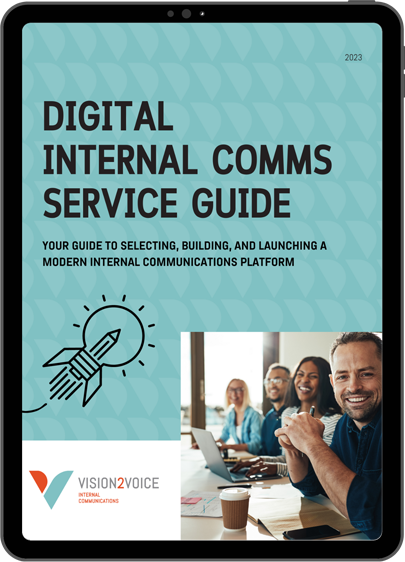
Get your free copy and be the first to hear about other resources, events, and content to help you take your IC game to the next level!
Get your free copy when you subscribe to our newsletter. Be the first to know about new blog posts and get valuable insights and ideas to improve your internal communications and build an awesome employee experience.

Get your free copy when you subscribe to our newsletter. Be the first to know about new blog posts and get valuable insights and ideas to improve your internal communications and build an awesome employee experience.
